

Butterfly Pea Tea Benefits: Blue Tea for Focus, Skin Health & Daily Wellness

|
Butterfly pea tea is a caffeine-free herbal infusion made from Clitoria ternatea flowers. Rich in anthocyanins – particularly ternatins – it supports mental clarity, skin health, relaxation, and antioxidant protection. It is one of the few herbal teas with both a well-documented wellness profile and a visually distinctive, colour-changing experience. |
Introduction
In a world of crowded wellness shelves and overpromised supplements, butterfly pea tea stands out – not through marketing, but through something genuinely rare: a combination of visual beauty, a long history of traditional use, and a growing body of scientific research.
Known as blue tea for its deep indigo colour, this herbal infusion is made from the dried flowers of Clitoria ternatea – a plant native to Southeast Asia that has been used in Ayurvedic and traditional Asian medicine for centuries.
It is completely caffeine-free, offers a mild floral flavour, and changes colour from deep blue to vivid purple when lemon or any acidic ingredient is added – a natural pH reaction that makes it one of the most visually engaging herbal teas available today.
But beyond the visual appeal, this blog explores what butterfly pea tea can actually do for your health – and what the research says.
What Is Butterfly Pea Tea?
Butterfly pea tea is a herbal infusion brewed from the dried flowers of Clitoria ternatea, a flowering vine found widely across India, Southeast Asia, and parts of Africa. It has a long history of use in traditional wellness systems – particularly in Ayurveda and Thai herbal medicine – for supporting cognitive function, eye health, and relaxation.
The tea contains a rich concentration of bioactive compounds:
- Ternatins — a group of anthocyanins unique to Clitoria ternatea; the primary source of its antioxidant activity and deep blue colour
- Anthocyanins broadly — the same class of antioxidant pigments found in blueberries, red cabbage, and other deeply coloured plants
- Flavonoids and polyphenols — quercetin, kaempferol glycosides, myricetin glycosides — contributing to anti-inflammatory and cellular protective properties
- Alkaloids and terpenoids — compounds associated with its traditional use as a cognitive and nervous system herb
Unlike most herbal teas, butterfly pea flower tea has a specific, well-studied compound profile – making the research behind it more targeted than many general herbal claims.
Butterfly Pea Tea Benefits: What Research Actually Supports
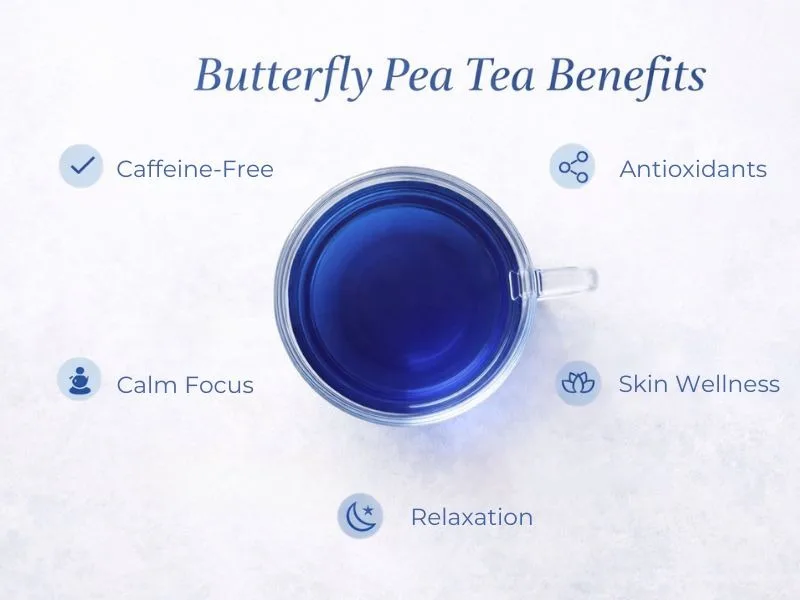
1. Exceptionally Rich in Antioxidants
The deep blue colour of butterfly pea tea is not cosmetic – it is a direct indicator of anthocyanin concentration. The darker and richer the blue, the higher the antioxidant content.
A 2022 study published in Scientific Reports measured the antioxidant and antibacterial activity of anthocyanin-rich fractions from Clitoria ternatea and confirmed significant free-radical scavenging properties. The ternatins in butterfly pea flowers are particularly well-studied for their ability to neutralise oxidative stress – the cellular-level damage linked to aging, chronic disease, and immune dysfunction.
|
The same class of antioxidants (anthocyanins) found in blueberries – widely regarded as one of the most antioxidant-rich foods – is found in high concentration in butterfly pea flowers. The colour is the signal. |
2. Supports Cognitive Function, Focus, and Memory
This is one of butterfly pea tea’s most clinically interesting benefits – and the one most relevant to students, professionals, and anyone doing sustained mental work.
Research published in Evidence-Based Complementary and Alternative Medicine found that butterfly pea flower extract can increase acetylcholine levels in the brain. Acetylcholine is a neurotransmitter directly associated with memory formation, learning, and sustained attention – making it central to cognitive performance.
A 2025 literature review on the effects of Clitoria ternatea on human health (ResearchGate, Santosa) confirmed that butterfly pea flower is believed to improve memory and brain function – one of the primary reasons research on this plant is accelerating globally.
|
Real-life example: For students preparing for exams, professionals doing deep work, or creatives needing sustained mental clarity – butterfly pea tea offers a calm, focused state without the overstimulation or energy crash associated with caffeine. It is particularly effective during mid-morning to afternoon work sessions. |
3. Supports Skin Health and Hair Vitality
The antioxidant and anti-inflammatory properties of butterfly pea tea extend meaningfully to skin and hair health – an area that has received significant research attention in recent years.
A study published in the Journal of Ethnopharmacology found that the flavonoids and polyphenols in butterfly pea flower promote collagen production, improving skin elasticity and reducing visible signs of aging. Collagen is the structural protein that keeps skin firm – and its production naturally declines with age and oxidative stress.
For hair, a 2024 study found that a 20% Clitoria ternatea shampoo significantly reduced dandruff severity. Separate research suggests butterfly pea extract may help promote hair growth and reduce hair loss through its effects on sebum management and follicle health.
|
Butterfly pea flower is already widely used in premium cosmetic formulations across Asia – in serums, hair oils, and shampoos – precisely because its topical benefits are well-established. Drinking it provides similar benefits systemically, from within. |
4. Promotes Relaxation Without Causing Drowsiness
Unlike chamomile or valerian, which produce a sedative, sleep-inducing effect, butterfly pea tea promotes a state of calm mental clarity – relaxed but alert. This distinction makes it especially useful during the day when you want to reduce anxiety or mental noise without losing focus.
Its alkaloid compounds interact with the nervous system in a way that supports parasympathetic activity – the “rest and digest” state – without crossing into drowsiness. This makes it distinct from most calming herbal teas, which tend to make you sleepy.
|
Real-life example: If you find yourself anxious, mentally scattered, or overwhelmed during a long work session – a cup of butterfly pea tea can help bring you back to a calm, focused baseline. It is not a sedative. It is a mental reset. |
5. Traditionally Used to Support Eye Health
Butterfly pea flower has a long history of use in Ayurvedic and Thai traditional medicine specifically for eye health and visual clarity. The anthocyanins in the flower are believed to support retinal health and may help protect against oxidative damage to eye tissue.
A 2025 literature review (Santosa, ResearchGate) confirmed that butterfly pea flower extract is known to be beneficial for improving eye health and potentially preventing cataracts – areas where ongoing research continues to develop.
6. May Help Moderate Blood Sugar Response
A study of 15 healthy men found that consuming beverages with butterfly pea flower extract combined with sucrose significantly reduced postprandial (post-meal) blood glucose and insulin levels within 30 minutes. This is attributed to the flower’s polyphenols and anthocyanins inhibiting alpha-amylase and alpha-glucosidase – two enzymes involved in carbohydrate digestion.
|
Important context: Results across studies are mixed, and more human trials are needed. This benefit is most relevant for people monitoring blood sugar as part of a broader dietary approach – not as a standalone intervention. |
7. Completely Caffeine-Free — Flexible for Any Time of Day
One of butterfly pea tea’s most practical advantages is its complete absence of caffeine. This makes it genuinely flexible – suitable for morning, afternoon, or evening – and accessible to people who are caffeine-sensitive, pregnant (consult a doctor), managing anxiety, or simply reducing their stimulant intake.
It can replace a second or third coffee without triggering the jitteriness or sleep disruption that caffeine-based alternatives cause.
8. The Colour-Changing Experience – More Than Aesthetics
When lemon juice or any acidic ingredient is added to butterfly pea tea, it shifts from deep blue to vivid purple. This happens because anthocyanins are pH-sensitive – they change the way they absorb and reflect light based on the acidity of their environment. This is not a gimmick. It is a direct demonstration of the purity and concentration of the botanical compound.
The colour change has made butterfly pea tea popular in cafes and on social media – but what it represents is a measurably high anthocyanin content, which is also what drives its health benefits.
How Butterfly Pea Tea Works: The Underlying Science
|
Compound |
Primary Mechanism |
Benefit |
|
Ternatins (anthocyanins) |
Neutralise free radicals, reduce oxidative stress |
Antioxidant protection, skin health, immunity |
|
Polyphenols & flavonoids |
Promote collagen synthesis, reduce inflammation |
Skin elasticity, anti-aging, cellular protection |
|
Alkaloids |
Modulate acetylcholine levels in the brain |
Improved memory, focus, learning capacity |
|
Quercetin & kaempferol |
Anti-inflammatory, enzyme inhibition |
Blood sugar moderation, reduced inflammation |
|
Terpenoids |
Interact with nervous system pathways |
Calm alertness, relaxation without sedation |
|
Unlike many herbal teas where the mechanism of action is vague or theoretical, butterfly pea flower has a relatively well-characterised compound profile – particularly its ternatin anthocyanins – which makes the research more specific and credible than most botanical wellness claims. |
Best Time to Drink Butterfly Pea Tea
|
Time of Day |
Primary Benefit |
Notes |
|
Morning |
Antioxidant start to the day |
Caffeine-free – won’t disrupt fasting or morning routine |
|
Mid-morning to afternoon |
Focus and mental clarity |
Ideal during study, deep work, or creative sessions |
|
After meals |
Blood sugar moderation support |
Most relevant when consumed with or just after food |
|
Evening |
Calm and relaxation |
Caffeine-free – will not disrupt sleep |
Most people consume 1-2 cups daily. There is no established upper limit, but moderation is always a sensible default with any herbal tea.
How to Prepare Butterfly Pea Tea
Butterfly pea tea is simple to brew and requires no special equipment.
Basic Method:
- Add 1 teaspoon (approximately 2g) of dried butterfly pea flowers to a cup
- Pour 200 ml of hot water at 80-85°C (avoid boiling water, which can degrade anthocyanins)
- Steep for 2-3 minutes for a lighter flavour, up to 5 minutes for a deeper blue
- Strain and enjoy warm, or allow to cool for an iced version
For the Colour-Changing Experience:
- Prepare as above to get a deep blue tea
- Add a squeeze of fresh lemon juice and watch it shift to purple
- The colour change is immediate and dramatic — determined by how much acid you add
Flavour Pairings:
- Honey — adds natural sweetness while complementing the floral notes
- Mint — adds freshness and a cooling contrast to the earthy floral base
- Ginger — adds warmth and amplifies the anti-inflammatory properties
- Lemon — adds vitamin C, brightens flavour, and triggers the colour change
Butterfly Pea Tea vs Other Herbal Teas
|
Tea |
Primary Benefit |
Caffeine |
Best For |
|
Butterfly Pea |
Focus, antioxidants, skin health |
None |
Daytime clarity, calm focus |
|
Chamomile |
Deep relaxation, sleep support |
None |
Evening wind-down |
|
Lemongrass |
Digestion, immunity, stress |
None |
Post-meal, afternoon |
|
Moringa |
Nutrition, natural energy |
None |
Morning vitality |
|
Green Tea |
Sustained energy, antioxidants |
Moderate |
Morning, focused work |
Who Benefits Most from Butterfly Pea Tea?
Butterfly pea tea is well-suited for a wide range of people:
- Students and professionals — seeking calm, sustained focus without caffeine dependence
- People reducing caffeine intake — a genuinely enjoyable, functional alternative
- Those focused on skin and hair health — benefiting from anthocyanin-driven collagen support
- Wellness-conscious individuals — looking for a daily antioxidant habit that is also visually appealing
- Anyone who values mindful rituals — the colour-changing experience adds a moment of pause and presence to the day
|
Who should exercise caution: Pregnant or breastfeeding women should consult a doctor before regular use. Those on blood-thinning medications or drugs metabolised by CYP450 liver enzymes should seek medical advice, as concentrated anthocyanin fractions may interact with these pathways. |
For Those Who Want Focus With Gentle Energy
Butterfly pea tea on its own is an excellent caffeine-free option for calm focus. But for people who want a similar experience with a gentle energy component, combining it with green tea creates a more complete cognitive support blend.
TwiCha ALERT is a blue pea green tea blend from the TwiCha collection by Camomila Botanicals – crafted specifically for creative focus and mental clarity. It combines:
- Green tea (50%) — provides gentle, sustained caffeine and L-theanine for alert-but-calm focus
- Butterfly pea flower (50%) — adds anthocyanin antioxidants, calming properties, and the vibrant blue colour
Together, they create a blend where the L-theanine from green tea and the calming alkaloids from butterfly pea flower work in the same direction — supporting focused attention without jitteriness or overstimulation.
|
Explore TwiCha ALERT A blue pea green tea blend crafted for creative focus, mental clarity, and calm productivity. Naturally vibrant. No artificial colours or additives. |
How to Build a Daily Butterfly Pea Tea Ritual
The value of any wellness habit is in its consistency. Here is a simple daily framework:
|
Time |
Habit |
Why It Works |
|
Morning |
Butterfly pea tea to start the day |
Antioxidant protection before food and environmental exposure |
|
Mid-morning / work hours |
TwiCha ALERT or plain blue tea during focus sessions |
Cognitive support without caffeine crash |
|
After meals |
A cup with lemon for the colour experience |
Blood sugar moderation + digestive support |
|
Evening |
Plain butterfly pea tea to wind down |
Caffeine-free calm without sedation |
|
Like all botanical teas, butterfly pea tea delivers its best results through consistent daily use over several weeks – not as a one-time remedy. The antioxidant and cognitive benefits accumulate gradually. The ritual, however, begins from the first cup. |
Explore More Wellness Guides
- Tulsi Tea Benefits: Immunity, Stress Relief & Daily Wellness (Complete Guide)
- Lemongrass Tea Benefits: Immunity, Digestion & Stress Relief
- Benefits of Herbal Tea for Daily Wellness: A Complete Guide
- TwiCha ALERT — Green Tea + Blue Pea for Focus
- TwiCha Tea Blends Collection — All Blends
Final Thoughts
Butterfly pea tea is one of the few herbal beverages that earns its wellness reputation on multiple levels: a well-studied compound profile, a long history of traditional use, and a sensory experience that makes it genuinely enjoyable to drink every day.
It is not a cure or a treatment. It is a functional daily ritual – one that supports cognitive clarity, antioxidant protection, and calm focus in a way that is both evidence-backed and genuinely pleasurable.
|
In a world of overcomplicated wellness products, there is something quietly powerful about a plant that has supported human health for centuries – and that also turns your cup a vivid shade of blue. |
|
Explore Our Botanical Tea Collection Camomila Botanicals crafts purposeful herbal blends for focus, immunity, calm, and daily balance – using natural, thoughtfully selected botanicals. Crafted in India. |