

Tulsi Green Tea Benefits: A Complete Guide to Energy, Focus, Immunity & Daily Wellness

| Quick Answer: Tulsi green tea combines green tea’s L-theanine and caffeine with tulsi’s adaptogenic compounds (eugenol, rosmarinic acid, ursolic acid). The result is a blend that provides steady energy without jitteriness, calm focus without drowsiness, and immune support without stimulation – three things neither ingredient alone can fully deliver. |
What Is Tulsi Green Tea?
If you have ever switched from coffee to green tea and still felt anxious, or tried plain tulsi tea and wished it gave you more energy, tulsi green tea may be the balance you were looking for.
Tulsi green tea is a blend of two botanicals: green tea leaves (Camellia sinensis) and tulsi (Ocimum tenuiflorum), also called holy basil. Each has its own established set of benefits. Together, they create something neither produces alone – a drink that offers energy and calm simultaneously.
This guide explains exactly how tulsi green tea works, what the research supports, who benefits most from it, and how it compares to plain green tea, plain tulsi tea, and coffee.
How Tulsi Green Tea Works: The Science of the Combination
To understand tulsi green tea benefits, it helps to understand what each ingredient contributes – and why they work better together than separately.
Green Tea’s Three Key Compounds
Caffeine – blocks adenosine receptors in the brain, reducing tiredness and increasing alertness. Approximately 15-30 mg per cup of tulsi green tea – significantly less than coffee (80-120 mg) but enough for meaningful alertness.
L-theanine – an amino acid found almost exclusively in green tea. L-theanine increases GABA, dopamine, and alpha wave activity – producing relaxed alertness. It works synergistically with caffeine: smoothing its stimulant effect and preventing jitteriness and anxiety.
EGCG (epigallocatechin gallate) – the primary catechin in green tea. A powerful antioxidant that supports immune cell function and provides anti-inflammatory and cellular protective benefits.
Tulsi’s Three Key Compounds
Eugenol – tulsi’s primary volatile oil. Documented anti-inflammatory, antimicrobial, and antiviral properties. A PMC study found eugenol specifically inhibits SARS-CoV-2 spike protein binding – highlighting its direct antiviral relevance.
Rosmarinic acid – potent antioxidant and anti-inflammatory. Works alongside EGCG from green tea through different molecular mechanisms – the combination is more comprehensive than either alone.
Ursolic acid – a triterpenoid supporting the body’s stress response and promoting emotional calm. One of tulsi’s three most pharmacologically active compounds.
| The key insight: L-theanine (green tea) and tulsi’s adaptogens work on overlapping but different neurochemical pathways. L-theanine modulates GABA and alpha waves. Tulsi regulates the HPA axis (stress-hormone system) and provides direct anti-inflammatory action. Together, they produce more complete stress-resilience and energy than either achieves alone. |
| TwiCha DEFENSE – A Ready-Made Tulsi Green Tea Blend
If you want a balanced, ready-to-brew tulsi green tea blend with clearly labelled ingredient ratios – TwiCha DEFENSE by Camomila Botanicals is specifically formulated around this combination: Green Tea (Camellia sinensis) – 50% · Lemongrass (Cymbopogon flexuosus) – 30% · Tulsi / Holy Basil (Ocimum tenuiflorum) – 20% The addition of lemongrass (30%) adds a third layer: citral’s antimicrobial properties complement tulsi’s eugenol and green tea’s EGCG – creating triple antimicrobial and antioxidant coverage in one cup. Made in India, FSSAI licensed, 100% natural. |
Tulsi Green Tea Benefits – Explained with Science
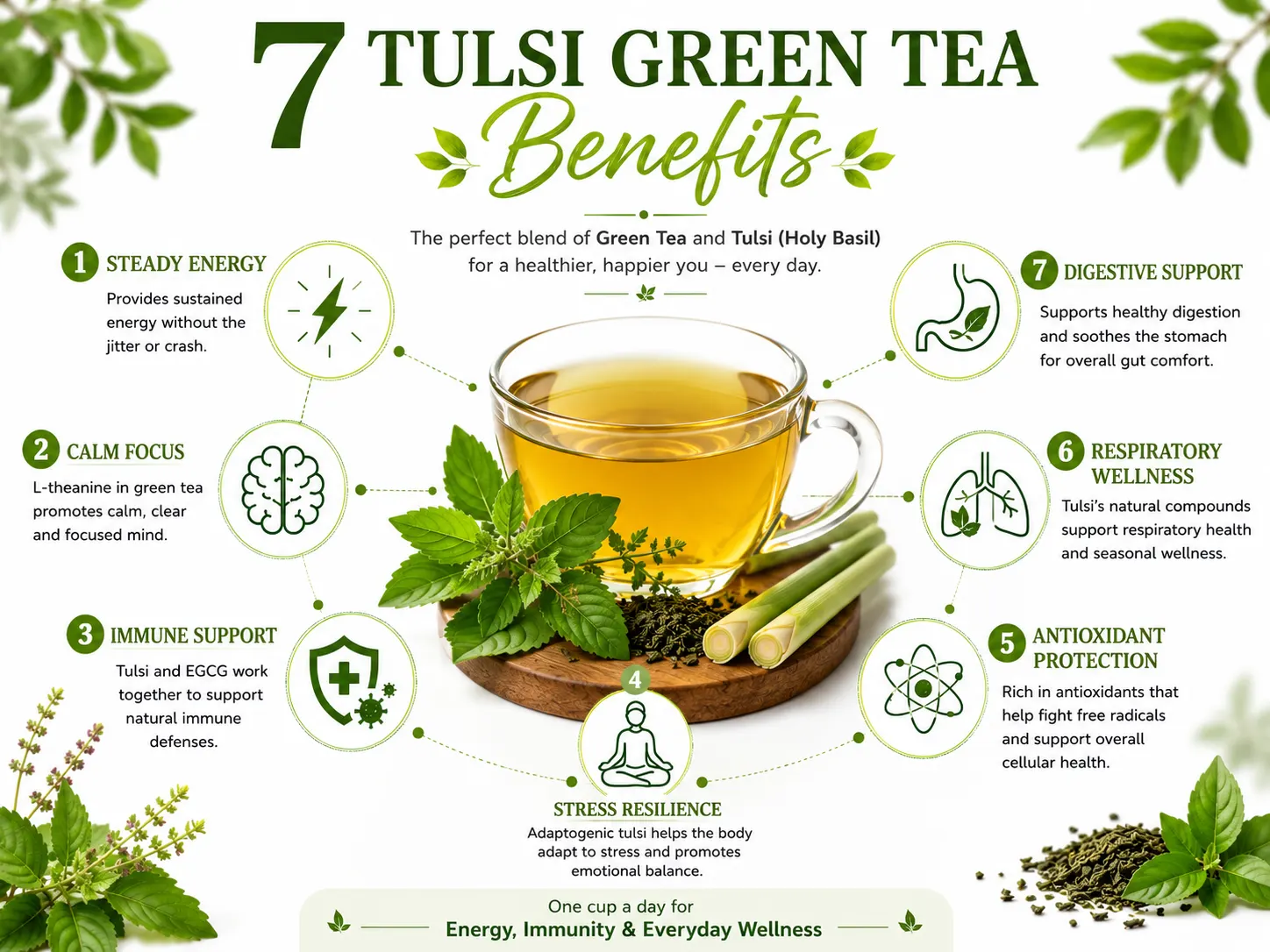
1. Steady Energy Without the Coffee Crash
This is the most commonly cited reason people switch to tulsi green tea – and the science supports it.
Coffee’s high caffeine dose (80-120 mg) produces a sharp energy spike followed by an adenosine rebound – the familiar mid-afternoon crash. Tulsi green tea contains approximately 15-30 mg of caffeine, delivering alertness without the spike-crash cycle.
L-theanine in green tea actively modulates caffeine’s stimulant effect. A landmark PubMed study found that L-theanine combined with caffeine significantly improved accuracy during task switching and self-reported alertness (P<0.01) and reduced tiredness (P<0.05) compared to caffeine alone.
Tulsi’s adaptogenic compounds add a third layer: by regulating cortisol through HPA axis modulation, tulsi prevents stress-induced energy drain. The result is energy that feels genuinely sustained – not artificially propped up by cortisol spikes.
| Real-life example:
An office professional drinking 3 coffees daily experiences sharp morning energy, mid-afternoon crash, and difficulty sleeping. Replacing the second and third coffee with tulsi green tea provides afternoon alertness without compounding caffeine load or disrupting sleep. |
2. Calm Focus – Not Anxious Alertness
This is what separates tulsi green tea from both coffee and standard energy drinks. Most caffeine sources produce alertness accompanied by anxiety or restlessness – particularly for caffeine-sensitive people.
A 2025 meta-analysis (MDPI Journal of Clinical Medicine, University of Szeged, PROSPERO registered) evaluating L-theanine across randomised placebo-controlled trials found L-theanine had a dose-dependent effect on cognitive function – improving visual information processing reaction time. A double-blind crossover trial (34 adults) found L-theanine significantly reduced subjective stress response and cortisol three hours post-dose.
Tulsi works on the same cortisol-reduction goal from a different angle – through HPA axis adaptogenic modulation rather than GABA. The combined effect is calm, focused alertness: the mental state most associated with productive, sustained work.
| Who benefits most:
Students during exam preparation, professionals doing sustained creative or analytical work, and anyone who finds coffee makes them anxious – tulsi green tea provides the cognitive lift without overstimulation. |
3. Immune Support That Works Daily
Tulsi has one of the most clinically documented immune profiles of any Ayurvedic herb.
A 2017 review in Evidence-Based Complementary and Alternative Medicine evaluated 24 studies on tulsi including five immunity studies. A small randomised double-blind placebo-controlled study found 4 weeks of tulsi extract supported healthy levels of natural killer (NK) cells and T-helper cells. The PMC review (PMC4296439) concluded tulsi can address physical, chemical, metabolic and psychological stress through a unique combination of pharmacological actions.
Green tea’s EGCG provides complementary immune support through a different mechanism: EGCG inhibits the growth of bacteria and viruses, reducing infection risk. Together, tulsi’s immunomodulatory adaptogenic action and EGCG’s antimicrobial protection create broader immune coverage than either provides alone.
| The immune combination: Tulsi regulates immune cell activity (NK cells, T-helper cells) through adaptogenic HPA modulation. EGCG provides direct antimicrobial and antiviral protection. These are complementary mechanisms – making the combination more effective than either alone. |
4. Stress Resilience – The Adaptogen Advantage
Tulsi is classified as an adaptogen – it helps the body adapt to and recover from physical, mental, and emotional stress.
L-theanine from green tea complements this directly: by reducing the cortisol response to stress and increasing alpha wave activity, it creates the physiological conditions in which tulsi’s adaptogenic action is most effective. Stress and caffeine both raise cortisol – L-theanine and tulsi both lower it through different pathways.
5. Antioxidant Protection – Two Pathways, One Cup
Both tulsi and green tea are rich in antioxidants – but they work through different molecular pathways, making the combination more comprehensive than either alone.
- EGCG from green tea – superoxide radical scavenging and metal chelation
- Rosmarinic acid from tulsi – hydrogen atom transfer and inhibition of lipid peroxidation
- Ursolic acid from tulsi – NF-kB pathway inhibition
Daily tulsi green tea provides antioxidant coverage across multiple pathways – more like a broad-spectrum protective intervention than a single-compound antioxidant supplement.
6. Respiratory and Seasonal Wellness
Tulsi has a particularly strong profile for respiratory support – one of the oldest documented uses of holy basil in Indian households.
Eugenol in tulsi has documented antimicrobial properties against respiratory pathogens. Green tea’s EGCG similarly inhibits viral entry into cells. For people in Indian urban environments exposed to seasonal infections and air quality fluctuations, the daily tulsi green tea habit provides consistent respiratory support that builds over weeks.
7. Metabolic Support and Digestive Comfort
Green tea’s catechins have documented thermogenic and metabolic effects. Tulsi complements this through the stress-digestion connection: chronic cortisol elevation disrupts gut motility; tulsi’s stress-reduction effect improves conditions for healthy digestion.
The combination provides mild digestive comfort – EGCG’s anti-inflammatory effect on the gut lining combined with tulsi’s traditional Ayurvedic digestive use creates a genuinely functional metabolic support ritual.
Tulsi Green Tea vs Plain Green Tea vs Plain Tulsi Tea vs Coffee
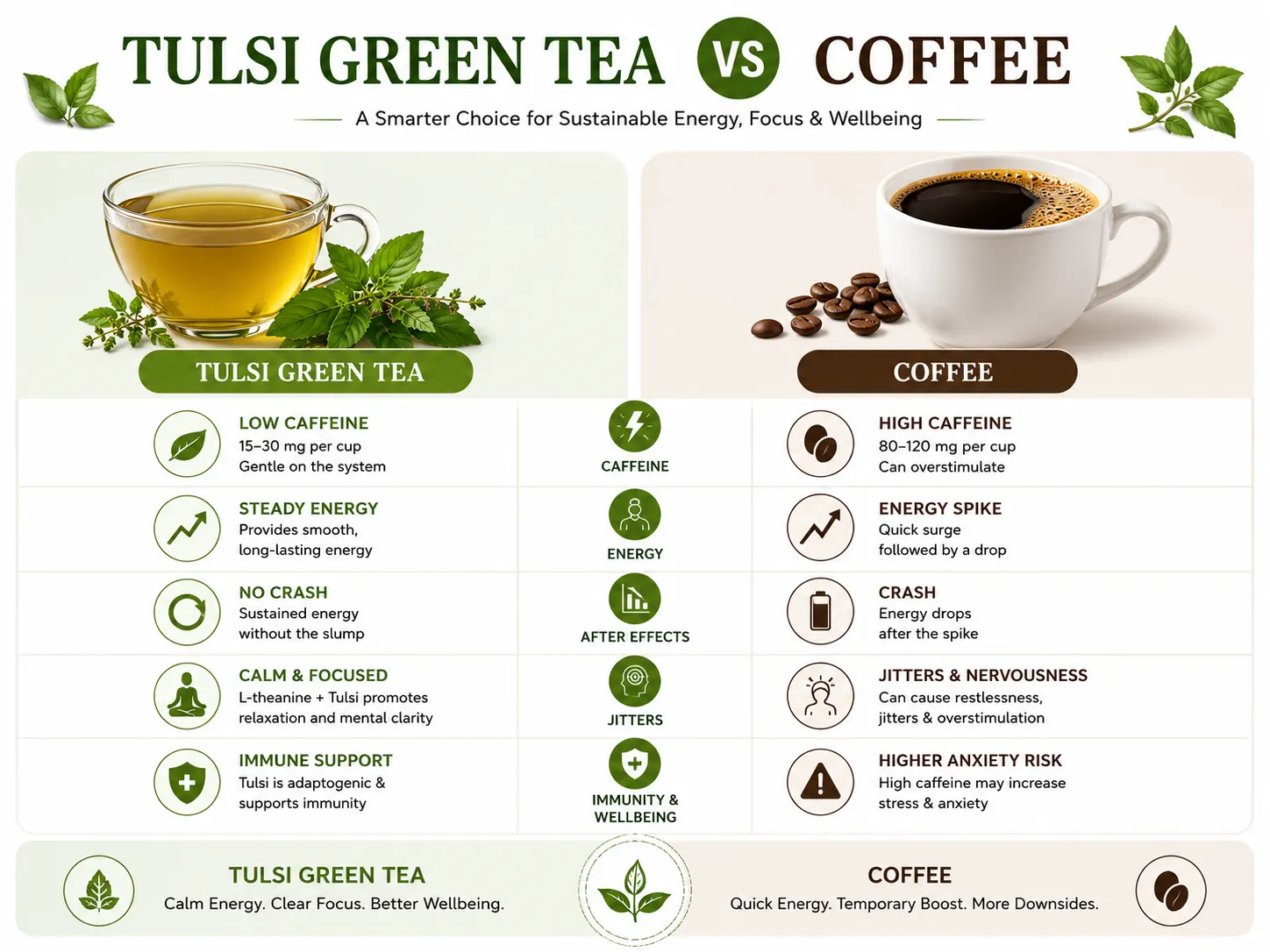
| Feature | Coffee | Plain Green Tea | Plain Tulsi Tea | Tulsi Green Tea |
| Caffeine | High (80-120 mg) | Moderate (20-40 mg) | None – caffeine-free | Low-moderate (15-30 mg) |
| L-theanine | None | Yes – calm focus | None | Yes – reduces jitteriness |
| Adaptogenic herbs | None | None | Yes – tulsi | Yes – tulsi |
| Energy quality | Sharp spike, crash | Sustained, mild | Calm energy (no caffeine) | Sustained + calm focus |
| Immune support | None | EGCG antiviral/antibacterial | Tulsi immunomodulatory | EGCG + tulsi (dual pathway) |
| Stress response | Raises cortisol | Mildly reduces (L-theanine) | Reduces (adaptogen) | Best reduction (L-theanine + tulsi) |
| Antioxidant coverage | Minimal | EGCG pathway | Rosmarinic + ursolic acid | EGCG + rosmarinic + ursolic |
| Best time | Morning only | Morning to afternoon | Any time, including evening | Morning to afternoon |
| Anxiety risk | High at normal doses | Low (L-theanine present) | None | Very low (L-theanine + tulsi) |
| The key takeaway: Tulsi green tea occupies a specific position that neither pure green tea, pure tulsi tea, nor coffee fills alone. More energy than plain tulsi tea. More calm focus than coffee. Better immune coverage than plain green tea. Less anxiety risk than all caffeinated options. |
| TwiCha DEFENSE: Green Tea + Tulsi + Lemongrass – Three Layers in One Cup
TwiCha DEFENSE takes the tulsi green tea combination a step further by adding lemongrass – creating a triple-action blend: Green Tea 50% – L-theanine + caffeine for calm focus + EGCG antioxidant immune support Lemongrass 30% – Citral: antimicrobial, anti-inflammatory, refreshing citrus character Tulsi 20% – Eugenol + rosmarinic acid: adaptogenic, immunomodulatory, stress-resilient The result: EGCG + citral + eugenol – three different antimicrobial and antioxidant compounds working through three different pathways simultaneously. This is why DEFENSE is specifically positioned as an immunity and daily wellness blend, not just a flavoured green tea. |
Tulsi Green Tea vs Tulsi Tea: What’s the Difference?
| Factor | Tulsi Tea (Pure Tisane) | Tulsi Green Tea (Blend) |
| Caffeine | None – completely caffeine-free | Low-moderate from green tea base |
| Best time | Any time – including evening and bedtime | Morning to early afternoon only |
| Primary benefit | Stress relief, immune support, respiratory wellness | Energy + calm focus + immune support |
| L-theanine | Not present | Present – moderates caffeine effect |
| Who it’s for | Caffeine-avoiders, evening ritual seekers | People wanting energy + wellness together |
| Flavour | Earthy, herbal, slightly clove-like | Herbal + grassy (green tea) – lighter body |
| Choosing between the two:
If caffeine sensitivity is a concern, or you want an evening drink – choose plain tulsi tea (caffeine-free). If you want daytime energy alongside tulsi’s adaptogenic benefits, choose tulsi green tea. Many people use both: tulsi green tea in the morning, plain herbal tisane in the evening. |
How to Prepare Tulsi Green Tea for Maximum Benefit
Standard Brewing Method:
- Use water at 80-85°C – never boiling. High heat degrades L-theanine and EGCG from green tea, and destroys tulsi’s volatile eugenol compounds
- Add 1 teaspoon (approximately 2g) of tulsi green tea blend to your cup
- Cover the cup while steeping – retains tulsi’s volatile aromatic compounds
- Steep for 2-3 minutes for lighter brew; up to 4 minutes for fuller flavour
- Strain and enjoy warm
Optional Additions:
- Lemon – adds vitamin C that enhances EGCG absorption; brightens the flavour
- Honey – complements tulsi’s earthy notes; mild prebiotic benefit
- Ginger (small piece during steeping) – amplifies tulsi’s anti-inflammatory and antimicrobial action
| Temperature is the most important brewing variable. 80-85°C preserves L-theanine, EGCG, and tulsi’s volatile compounds. A simple rule: boil water, wait 2-3 minutes, then pour. |
Best Time to Drink Tulsi Green Tea
| Time | Why It Works | Best For |
| Morning (7-9 AM) | L-theanine + caffeine at natural cortisol peak – amplifies focus without overstimulation | Morning routine; starting the day with immune + adaptogenic foundation |
| Mid-morning (10-11 AM) | Caffeine still active; L-theanine alpha wave state ideal for focused work | Deep work, studying, creative tasks requiring sustained attention |
| Early afternoon (12-2 PM) | Extends focus into post-lunch window; low caffeine unlikely to disrupt sleep | Afternoon productivity; avoiding post-lunch energy dip |
| Avoid after 3-4 PM | Even low caffeine from green tea can affect sleep for sensitive individuals | Switch to caffeine-free herbal tisane for evening |
What the Research Says: Key Evidence
On L-Theanine + Caffeine Combination (Green Tea)
A 2025 meta-analysis (PMC12609247, University of Szeged, MDPI Journal of Clinical Medicine) systematically evaluated L-theanine’s cognitive effects across randomised placebo-controlled trials. Results: L-theanine had a dose-dependent effect on cognitive function – improving rapid visual information processing and reaction time (MD: -15.20 ms; 95%-CI). An earlier PubMed RCT confirmed L-theanine + caffeine significantly improved task-switching accuracy (P<0.01) and reduced tiredness (P<0.05).
On Tulsi’s Adaptogenic and Immune Properties
A PMC systematic review of tulsi (PMC4296439) concluded: “There is mounting evidence that tulsi can address physical, chemical, metabolic and psychological stress through a unique combination of pharmacological actions.” Five immunity studies found tulsi supported NK cell and T-helper cell levels and immune response to viral events.
On EGCG + Tulsi Immune Synergy
A Halmaritea analysis of the combination confirmed: “EGCG inhibits the growth of bacteria and viruses, reducing the risk of infections. The combination of Tulsi and green tea creates a synergistic effect, enhancing the body’s ability to fight off pathogens more effectively.” The two ingredients’ immune mechanisms are complementary – EGCG provides antimicrobial/antiviral protection while tulsi regulates immune cell activity.
Who Should Be Careful with Tulsi Green Tea
- Pregnant women – both caffeine and tulsi warrant medical guidance during pregnancy
- Caffeine-sensitive individuals – even 15-30 mg may cause sensitivity; plain tulsi tea is the appropriate alternative
- People on blood thinners (warfarin) – EGCG may interact; seek medical advice
- People with hyperthyroidism – green tea’s EGCG may affect thyroid at high doses; consult your doctor
| For most healthy adults drinking 1-2 cups of tulsi green tea daily, no safety concerns apply. The low caffeine dose and well-established safety profiles of both green tea and tulsi make this a safe daily wellness drink. |
Explore More Wellness Guides
- Tulsi Tea Benefits: Immunity, Stress Relief & Daily Wellness (Complete Guide)
- Lemongrass Tea Benefits: Immunity, Digestion & Stress Relief
- Benefits of Herbal Tea for Daily Wellness: A Complete Guide
- TwiCha DEFENSE — Green Tea + Tulsi + Lemongrass for Daily Immunity
- TwiCha Tea Blends Collection — All Blends
Final Thoughts
Tulsi green tea is genuinely useful – but it is worth being precise about why.
It is not the most potent source of L-theanine (that would be matcha). It is not the most potent source of tulsi adaptogens (that would be a concentrated extract). What it is, is a well-balanced daily drink that combines meaningful amounts of both in a convenient, pleasant, genuinely enjoyable format.
The benefits – energy without jitteriness, calm focus without drowsiness, immune support through two complementary mechanisms, and daily antioxidant protection – all come from consistent use. One cup occasionally does little. One cup daily over several weeks produces the cumulative benefits that the research supports.
| Looking for a Ready-Made Tulsi Green Tea Blend?
TwiCha DEFENSE combines Green Tea (50%), Lemongrass (30%), and Tulsi (20%) in a transparent, clearly labelled formulation – crafted in India, FSSAI licensed, with no artificial additives. It is designed as a daily morning immunity and wellness ritual – exactly the consistent daily habit this guide recommends. The three-ingredient combination – L-theanine + EGCG from green tea, citral from lemongrass, eugenol + rosmarinic acid from tulsi – provides energy, focus, antimicrobial protection, and adaptogenic stress resilience in a single morning cup. Explore TwiCha DEFENSE — Rs.499 · Free Shipping Across India → |
| Disclaimer: This article is for informational purposes only and is not intended as medical advice. TwiCha DEFENSE and other Camomila Botanicals products are not intended to diagnose, treat, cure, or prevent any disease. Consult your doctor if you have any health conditions before adding new herbal beverages to your routine. |